Stations Near You
How to find a community station on the dial
Every county in America has more radio on it than the commercial logos suggest, and finding a low-power community station is mostly a matter of knowing where on the dial and in which database to look.
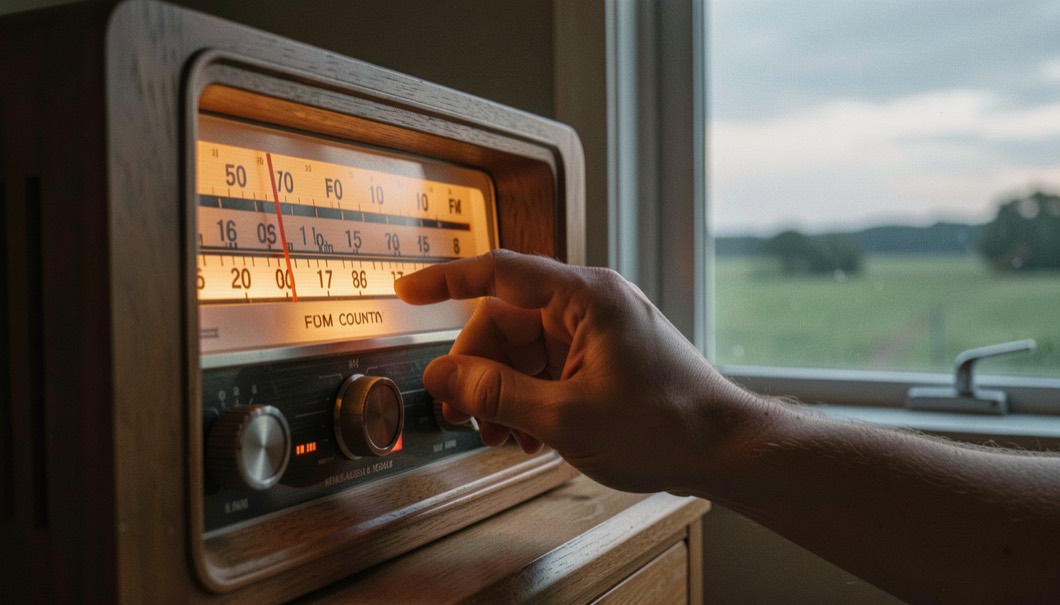
The FM band looks continuous, but it is laid out like a street with numbered lots. American FM channels sit only on the odd tenths of a megahertz, 200 kHz apart, which is why a scan walks from 92.1 to 92.3 to 92.5 and never touches 92.2. One channel of that street, from 88.1 to 91.9 MHz, is reserved for educational broadcasting; the rest, from 92.1 to 107.9 MHz, is the non-reserved band where the low-power FM service was placed in 2000. A community station can therefore hide between two commercial signals on almost any stretch of the dial, and the first skill of a listener is knowing that the gaps are not empty on purpose.
Scan with the dial, confirm with the databases
Start with the radio you own. An evening scan in a car, which usually has the best receiver antenna in your household, will surface signals a kitchen clock radio misses, and low-power stations at the edge of their range often appear with a hiss that gets cleaner block by block. Call signs help you interpret what you find: stations east of the Mississippi River begin with W, stations west of it begin with K, and a four-letter call with the suffix LP after it, such as those many low-power stations display on air, marks a licensed LPFM rather than a pirate or a repeater.
Then confirm what you heard. The Federal Communications Commission licenses every legitimate station and publishes the assignment in its LMS broadcast database, searchable by community, frequency or call sign. Two volunteer services make the same data friendlier: Radio-Locator has mapped every licensed American station, including the low-power ones, with coverage maps for decades, and REC Networks publishes a free LPFM channel finder built by and for the community radio movement. Ten minutes across those three sources turns a mysterious hiss into a call sign, a community of license and a studio address.
What you will find when you tune slowly
Community radio is a family of strangers. Campus stations, many of them on the reserved band, trade top 40 for student programming and local sports; our guide to the reserved band explains why the colleges got that frequency range in the first place. Low-power stations carry high school football, city council replay, bilingual public affairs, hymn hours, garden shows and more local music than any commercial operator would risk. Religious broadcasters and translator repeaters occupy plenty of channels too, and a listener who sorts them by call sign and license class within a minute of scanning will quickly learn which signal is local and which is a satellite feed with a local frequency.
The sound itself deserves patience. A 100-watt station covers a radius of roughly three and a half miles in flat country, less in hills, and the edge of its contour is noisy in exactly the way the sound of a 100-watt station guide describes. A cheap receiver with a mono switch, a wire antenna strung along a bookshelf or simply a room on the right side of the building can convert a marginal signal into a pleasant one, and a station you can only hear at night is often a station whose antenna points away from you rather than a station about to disappear.
Keep a listening log, because the dial moves
Licensed signals rarely vanish, but they do change: a community group wins a construction permit in a filing window and appears on a quiet frequency; an aging volunteer board signs off on a Sunday; a station that began as a pirate project in the 1990s, like the ones remembered in our pirate radio history, takes legal calls and moves up the dial. A one-page log of date, frequency, call sign and what you heard turns your listening into a small civic record of your county, and it is the same habit a founding group uses when it studies a channel before applying.
Listening is also the first step of the other direction. Nearly every volunteer who has helped launch a station began as a devoted listener of somebody else’s, and the roadmap in how to start an LPFM station starts with weeks of exactly this dial homework. The band rewards attention: the more slowly you scan, the more your community turns out to have been broadcasting all along.