LPFM Rules Made Simple
Protections, offsets and shared dial space
The FM band is a geometry problem: every new signal must prove it will not hurt its neighbors, and the FCC’s spacing rules decide where a 100-watt station may legally stand.
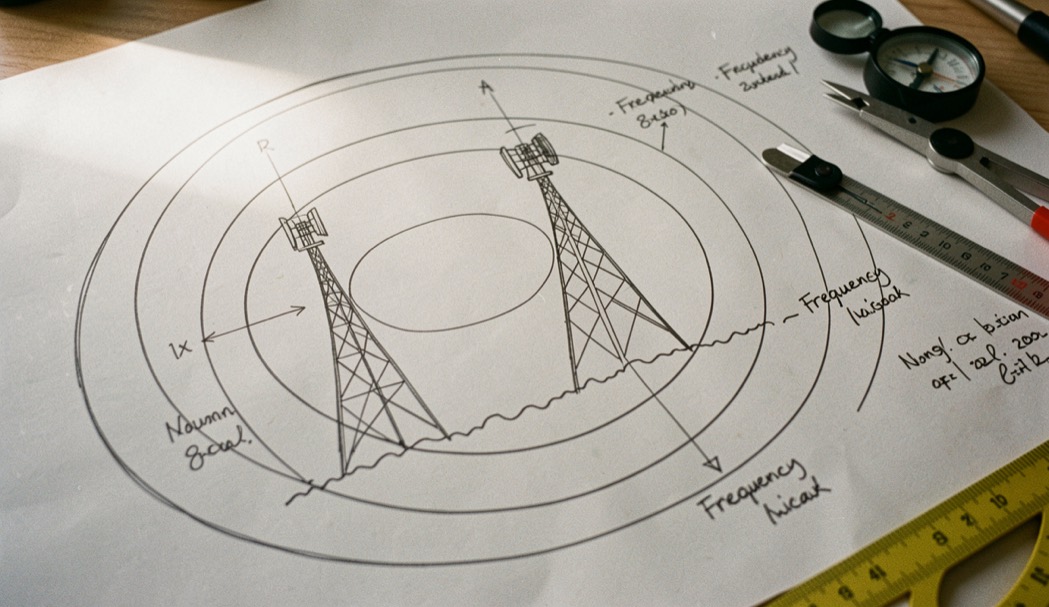
Every frequency on the FM band is surrounded by invisible rings. A full-power station’s service area must be protected from interference, so the FCC allows no new assignment on the same channel inside that protected contour, and stricter rings on the immediately adjacent channels, one step up and one step down the dial, because FM receivers must separate neighboring signals to tune at all. A second-adjacent channel carries a smaller ring, and beyond that the band opens up. When the LPFM service was created in 2000, these spacing rules determined the entire map of where a low-power station could exist, which is why the hunt for a channel, described in the startup roadmap, is really a hunt through geometry.
The third-adjacent fight, and the 2011 fix
The original rules carried an extra ring: low-power stations were barred from third-adjacent channels as well, a restriction attached by Congress in the Radio Broadcasting Preservation Act of 2000 after full-power broadcasters argued that cheap receivers could not filter a station three channels away. The ban quietly deleted thousands of otherwise usable channels, especially in towns with full dials. Years of field experience contradicted the interference predictions, and Congress reversed itself in the Local Community Radio Act, signed on January 4, 2011, which removed the third-adjacent requirement while keeping protections for the co-channel, first-adjacent and second-adjacent positions, plus special guard bands for commercial radio reading services and TV channel 6, whose audio some analog sets still receive. That statute is the reason many of the LPFM stations licensed after the 2013 window exist at all: their channels had been invisible for a decade, and the movement that fought for them treats the 2011 act as its central legislative victory.
The 10 kHz offsets, explained over one cup of coffee
Here is the trick that puzzles every newcomer: some low-power stations are licensed at frequencies that look wrong, sitting between the familiar grid points, such as a clear signal answering at 101.6 MHz when the printed dial lists only 101.5 and 101.7. These are offset assignments. FM receivers are more tolerant than the standard grid assumes, and the FCC may authorize an LPFM on a 10 kHz offset from a standard channel when the shift lets the station keep all its required protections while squeezing into dial space a full channel cannot occupy. The offset station trades a little receiver comfort at the edges of its contour for existence, and engineering studies filed with the application demonstrate the trade is safe. When a channel finder returns an offset candidate, as volunteer tools described in the dial search guide often do, it is offering exactly this bargain.
When to bring in an engineer
Volunteers can and should do the first pass themselves: the channel finders, the directory maps and the distance arithmetic in the rules are public and legible. The professional study earns its fee at the moment a group narrows to one or two candidate channels, because the filed engineering exhibit is what the FCC relies on and what a rival will attack first. Engineers price this work modestly by broadcast standards, and a study that blesses a channel before the window is the cheapest insurance an applicant buys; a study that kills a channel before the window is even cheaper, since it redirects the group toward an open frequency instead of a lost race.
Reading the rules as a map, not a fence
Groups should read the protection rules as a map with room on it. A clean channel study considers the co-channel and adjacent stations, the distance separators in the rules, populations inside protected contours, and the odd corners where an offset unlocks a site everyone else overlooked. It also respects the quiet carve-outs: translator stations feeding other broadcasters, FM booster signals and the reading services for print-disabled listeners all carry protections a volunteer will not see from the car radio. The geometry never disappears; the 2011 act only made the map larger. What the rules buy, when a group studies them patiently, is certainty: a station that fits the geometry at licensing will not be dragged into an interference dispute at sign-on, and the coverage it promises is the coverage it keeps.