Emergency Broadcasting
A community station’s storm playbook
When the warning sounds, the smallest station in town may be the only media outlet still running on generator power and volunteer nerve, and the difference is a playbook written on a calm day.
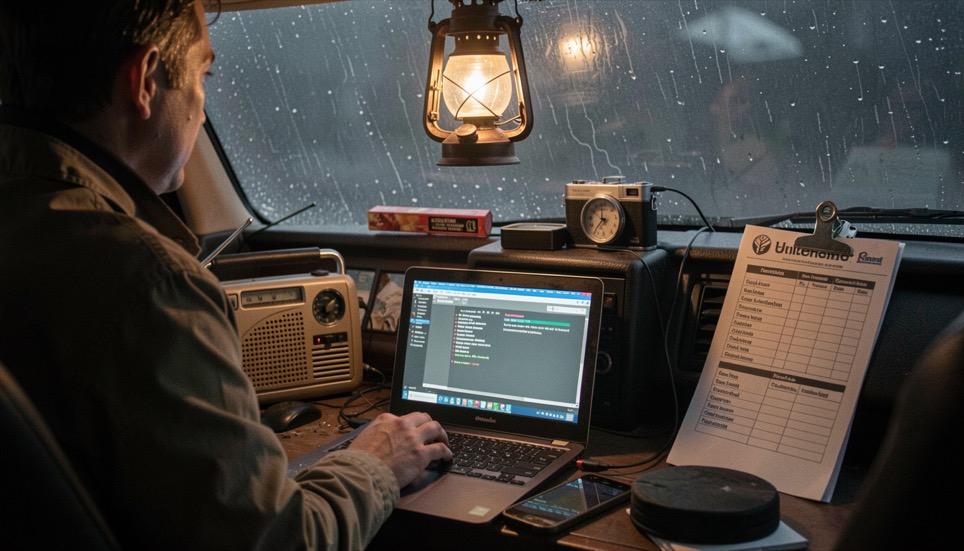
Every community station has one perfect storm story: the night the sirens went off, the ice that took the power lines down, the flood where the only working local transmitter turned out to be yours. The stations that shine in those hours did not improvise; they wrote a playbook on a calm day and drilled it. This page is the template, written for a 100-watt station with a volunteer bench and a modest budget, ordered by the hours before the weather arrives.
Before the season: power, signal, paper
Three purchases decide most storm outcomes. Power: a generator sized for the transmitter and a small studio load, exercised monthly with fuel rotated, plus battery units for the console and a surge-protected path so the station can come back after the flicker rather than after the insurance claim. Signal: a NOAA Weather Radio receiver with SAME county coding on the console, tuned to one of the seven weather channels from 162.400 to 162.550 MHz, so official warnings arrive even when the internet and the EAS relay are dark; the EAS beginner’s guide explains how that feed fits the national machinery. Paper: the contact tree, laminated, with two ways to reach every board member, engineer and key volunteer, because the day of the storm is the worst day to learn whose number changed. While the sky is clear, build the podcast bench too, since trained editors double as trained operators.
When the warning sounds
The playbook hour runs on short rules. Read only official text: the weather service wording, the shelter addresses, the boil-water notice, verbatim, because a paraphrased evacuation line is a liability and a misread road name is a danger; the accuracy rules from the EAS guide govern the microphone. Keep the schedule skeleton so listeners can orient: familiar segments, even simplified ones, signal that the station is stable. Repeat the critical facts on a short loop, because a listener tuning in mid-sentence missed the first version. Bring the community onto the air carefully: caller reports of blocked roads and downed lines are useful only when read as unverified and attributed, and the phone lines need one operator whose only job is triage. If the transmitter site floods or the tower light dies, know the failover before you need it, a question the engineering half of the startup roadmap should have answered in writing.
The long hours: rotation and the hand-off
Extended events, an ice storm, a flood crest, a night of tornado warnings, are won by rotation, not heroics. The playbook names an anchor rotation of two to three hours on console, a second operator resting within reach, and a phone desk keeping the contact tree warm; nobody important should be irreplaceable at 3 a.m. It also names the hand-off: if the studio fails or the building empties, the designated backup, a laptop with a microphone, a battery unit and the remote encoder credentials, restores a reduced on-air presence from anywhere with power. Rehearse both once a season, on the air, so the first time the hand-off happens is not the night it matters. Long events also invent programming on the fly: a log of who called, what was read and when the official word changed becomes the station’s report to its community and its own best argument during the next fundraiser.
After the sky clears
The recovery hours are part of the playbook. Debrief within a week, in writing: what failed, what the generators actually ran, which names on the tree answered. Thank the volunteers by name on air, because the bench that stayed up all night is the station’s real infrastructure. Restock what was consumed, refuel and re-exercise the generator, update the laminated pages, and archive the broadcast the way the workshop teaches, since the recording of a station serving through a storm is both institutional memory and the finest membership appeal a community station owns. A storm, in the end, is the annual audit of everything this magazine believes about small stations: the voice the neighborhood trusts is the one it will look for in the dark, and the listener-owned station is the one that will still be there to answer.